
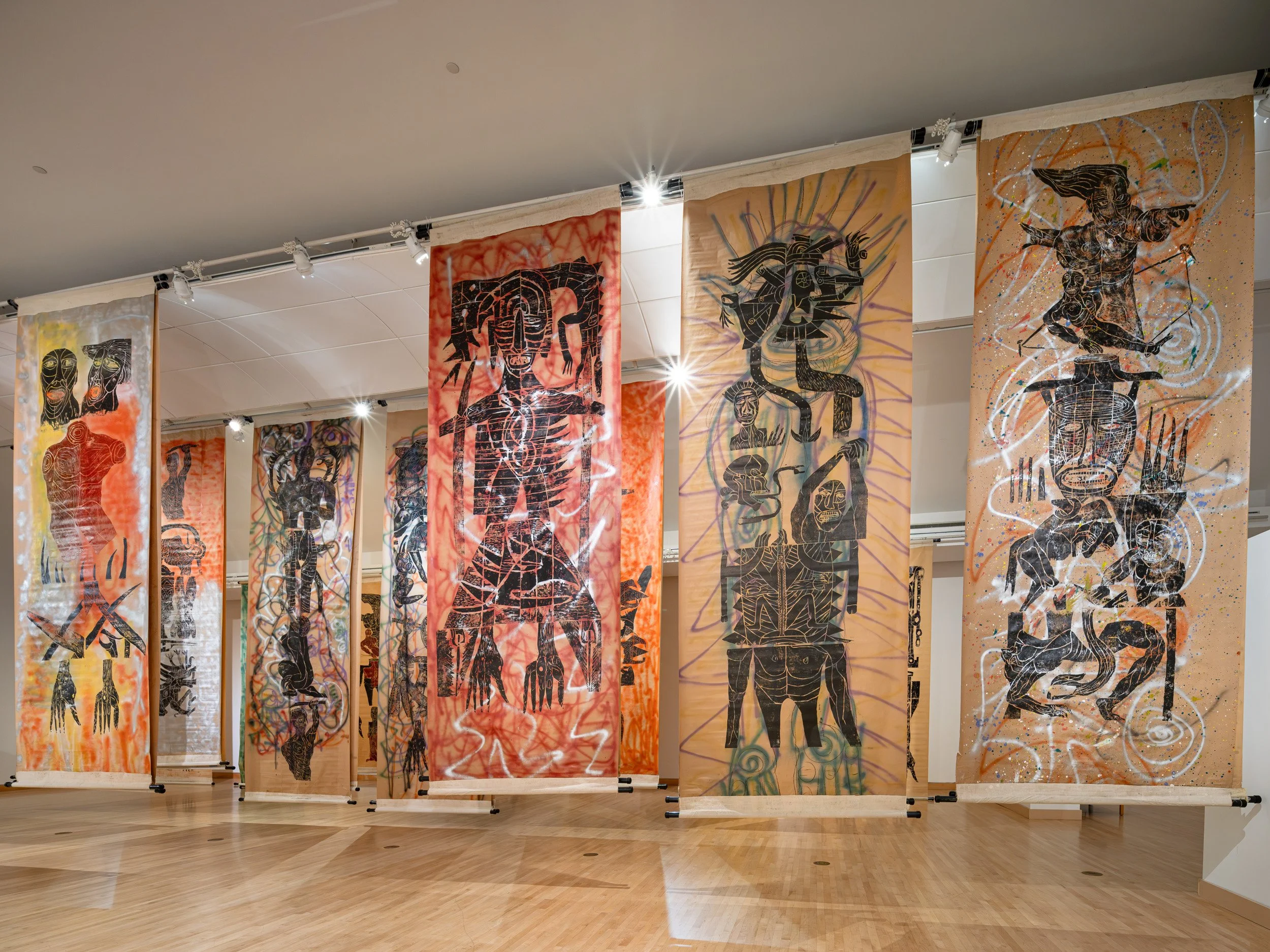
Image: José Hugo Sánchez: Amoxtlis, Installation view, California Center for the Arts Museum, June 6 — August 16, 2026. Photo: Philipp Scholz Rittermann.
Printmaking and the Contemporary Amoxtli with José Hugo Sánchez
Dates: Sundays, October 18–December 13, 2026 | 12:30–4:30 PM
Location: Museum Art Lab
$400 per participant for eight sessions, including materials
Registration deadline: October 16
This workshop series introduces participants to the artistic language of relief color printmaking while exploring the symbolic universe of the amoxtli/Codex Borgia, one of the greatest pictorial manuscripts of ancient Mesoamerica.
Participants will learn both the practical techniques of color printmaking and the philosophical foundations of the amoxtli/codex tradition. Throughout the workshop students will create an original contemporary amoxtli/codex, interpreting present-day life through symbols, narrative sequences, memory, family, community, ecology, contemporary mythology, ritual and personal experience. Students will study its visual language and reinterpret its principles through contemporary practice.
This workshop series combines historical knowledge, studio production, creative research, and personal reflection. Each participant will develop original imagery and assemble a finished book. Each session combines discussion with demonstrations and guided studio work. Sánchez will provide individual feedback as you develop your imagery, refine your printing techniques, and bring your book together.
Organized by the California Center for the Arts Museum in collaboration with José Hugo Sánchez.
Who This Workshop Is For
This series is for adults and teens ages 15 and older interested in printmaking, artist books, and visual storytelling. Instruction begins with tool safety and introductory relief-printing techniques before progressing to multicolor printing and book assembly.
The sessions build on one another, so participants should plan to attend the complete series.
What You’ll Learn and Make
Throughout the course, you will:
Explore how images and symbols communicate meaning in the Codex Borgia and develop your own imagery in response.
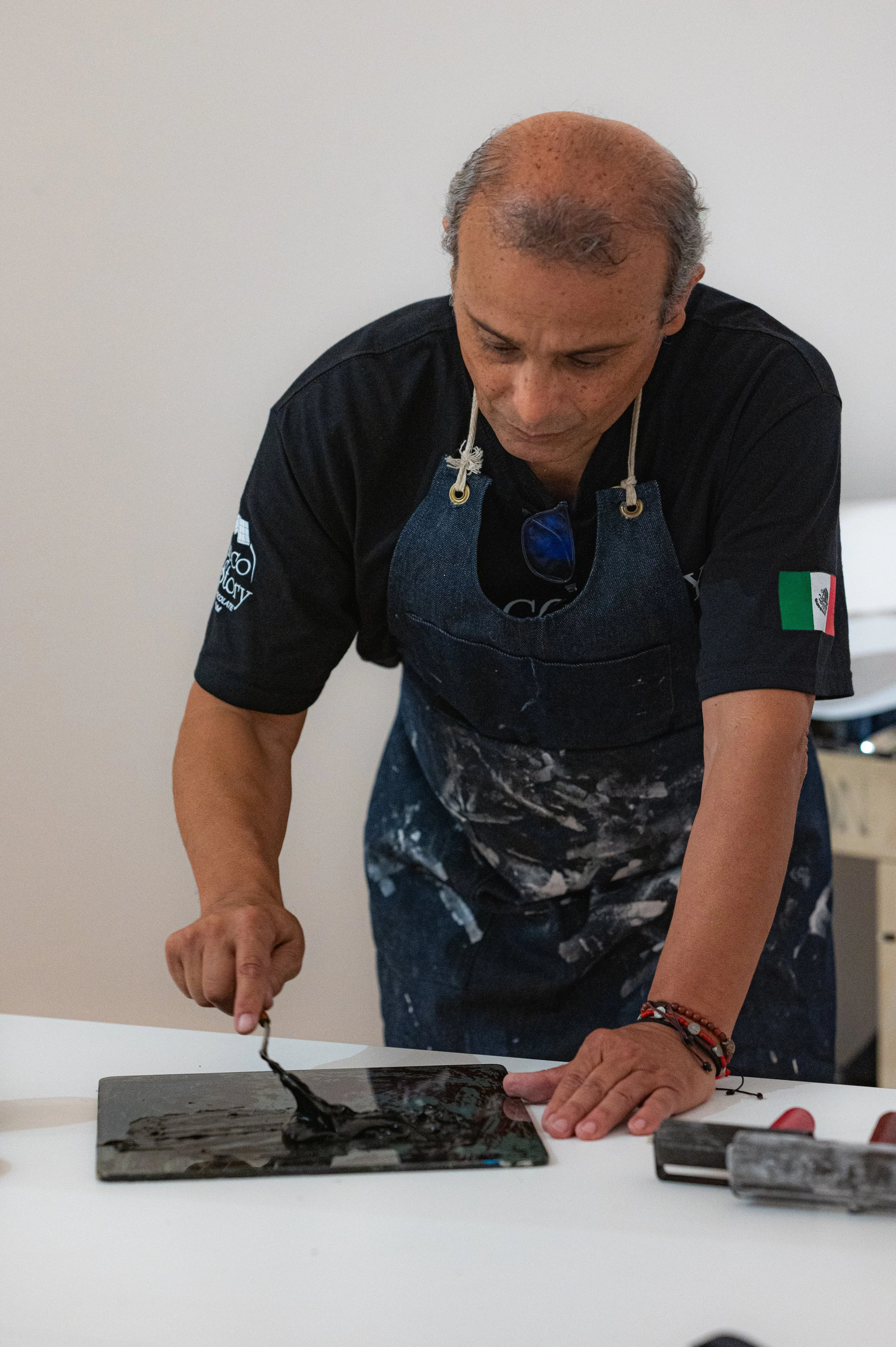
Transfer drawings to linoleum and use carving tools safely.
Mix printing inks and use registration methods to align successive layers of color.
Organize individual prints into a connected visual narrative.
Assemble and finish an original pictorial book.
You’ll leave with a contemporary amoxtli of your own design and practical experience in relief color printmaking.
Weekly Schedule
October 18 | Introduction to Pictorial Storytelling and Relief Printmaking
Begin with an introduction to the Codex Borgia and its use of images and symbols to communicate meaning. Drawing exercises will help you develop ideas for your own pictorial book. In the studio, learn safe handling of carving tools and make practice cuts in linoleum, exploring texture and the relationship between printed and unprinted areas.
October 25 | Creation Stories and Personal Imagery
Explore representations of creation, deities, and the natural world in the Codex Borgia. Use the discussion as a starting point for developing your own visual vocabulary. Learn methods for transferring drawings onto linoleum, begin carving your first image, and pull a black-ink proof to assess the design and identify areas for refinement.
November 1 | Ritual and the Introduction of Color
Consider how images convey ceremony, offerings, and the cycles of human life. Continue refining your carved imagery while preparing additional blocks for color printing. Learn to mix inks and establish a registration system—a method for aligning successive impressions—before printing your first color layers.
November 8 | Calendars and Layered Color
Discuss the relationships between time, numbers, and recurring cycles in the Codex Borgia’s divinatory calendar. In the studio, build on your earlier prints by adding color layers. Experiment with transparent ink and overlapping colors while refining registration and considering how color changes the mood and readability of an image.
November 15 | Dreams and Symbolic Imagery
Develop images that explore dreams, animal companions, and changes in identity. Continue developing your own images through multiblock printing. Experiment with texture and repeated forms, considering how layered imagery and visual rhythm can connect one page of your book to the next.
November 22 | Contemporary Stories and Book Development
Consider how symbols can communicate experiences of migration, community, or environmental change. Begin arranging your prints into a contemporary amoxtli, deciding how the story unfolds across multiple pages. Combine printed imagery with collage or other media, and identify any additional images needed to complete the sequence.
November 29 | No Class
December 6 | Printing and Assembling the Amoxtli
Discuss how pictorial storytelling can help us reflect on contemporary life and imagine the future. Complete remaining prints and edit your page sequence with guidance from José. Learn assembly, binding, and finishing techniques as you bring the individual pages together into a finished book.
December 13 | Finishing and Sharing Your Work
Complete final printing and finishing details, then photograph your work for documentation. Share your amoxtli with the group and discuss the imagery, technical decisions, and experiences that shaped it. The series concludes with a presentation of participants’ books and prints and a reflection on the creative process.
About José Hugo Sánchez
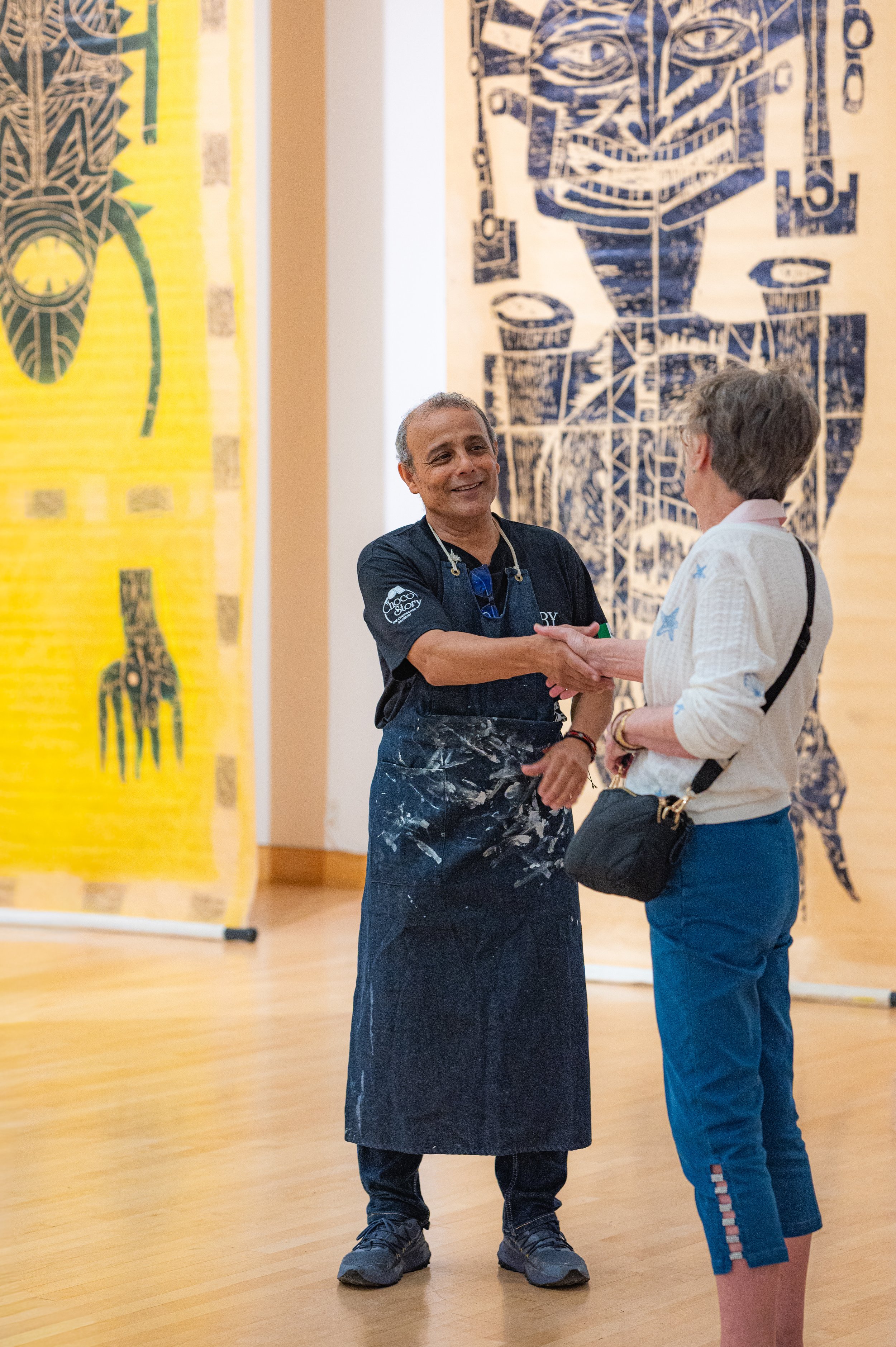
José Hugo Sánchez is a multidisciplinary artist and educator whose practice centers on monumental printmaking and the cultural exchanges between Mexico and the United States. Drawing from Mesoamerican codices, contemporary Chicano visual culture, and mass media, he develops a visual language he describes as “pop-multiculture.”
His exhibition history includes Polinización at the Museo Nacional de la Estampa in Mexico City and Umbra: New Prints for a Dark Age, selected by Alison Saar at International Print Center New York. Centro Cultural Tijuana presented a retrospective marking thirty years of his artistic practice in 2014. His work has also been exhibited at the San Diego Art Institute and internationally.
Sánchez brings extensive experience teaching printmaking and monumental image-making. His teaching residencies have included San Diego Mesa College, Universidad Autónoma de Zacatecas, Academia de las Artes de San Alejandro in Havana, and Centro de las Artes de Baja California in Mexicali. He also founded La Huella, a printmaking research workshop at Centro Cultural Tijuana.
Materials and Registration
The registration fee includes all required materials, including linoleum blocks, carving tools, printing inks, paper, and printing supplies. The eight-session series provides 32 hours of instruction.
Enrollment is limited to 20 participants. A minimum of 15 registrations is required by October 16, 2026. If minimum enrollment is not met, the fall series will be rescheduled for January 2027. Registered participants will be notified and may choose to transfer their registration or receive a full refund.
Questions
For program questions or accommodation requests, contact:
Belen Torralba, Museum Education Coordinator, at btorralba@artcenter.org.